Even after the U18 worlds and the NHL Combine concluded the scouting season, the top end of this draft is still a difficult one to handicap. The top two ranked players are slightly undersized wingers, but ultra-talented in different ways. Then there’s a group of five defencemen, three of whom are right-handed, and all of whom possess NHL size. Mix in a couple of centres, two or three who could be top 10 picks, and voila, we have a recipe for fun.
NHL Draft fans and the general hockey-watching public are always anxious to define tiers in a draft class. If I had to do so, I’d say there’s a top three, then the next five, then a group of another five players to make up three tiers across the first 13 picks. After that, I see another grouping of 10 or so players to take us into the range of the top 23 before there’s more variance.
On that topic, a number of draft projections will vary greatly, beginning at No. 1. Heck, my colleague Jason Bukala and I (see his final rankings here) can’t even arrive at a consensus No. 1. Several others who put a ton of work into this space also have different orders among even the top five and top 10 players. These widespread thoughts speak to the closeness of this draft class.
The U18 tournament tends to lift players more than it hurts them, and this year is no different with the emergence of a few players, whom we will make note of later on in this piece.
The NHL Combine is something that I think goes underrated in the draft process. I speak, however, from the bias of someone who places high value on personal interaction and communication. While those are not traits that equate to on-ice talent, they are important in projecting what a player may become, or more importantly what he may not become.
More teams are starting to expand their exercise and sport science departments, and as this happens, those teams are starting to take the physical testing results and medical reports more seriously than in the past. If a player is weak, can a team exploit opportunity? If a player is strong, how much stronger can he get before his play is impacted? Lastly, are there predictive signs that can be seen in either the medicals or the testing that can help identify future health problems or opportunities for development?
Keep in mind, Bukala and I will have mock drafts coming out during draft week, which are different in that we will be projecting which teams will pick which players. In the meantime, here are my latest NHL Draft rankings, which do not take into account which teams are picking in which slot.
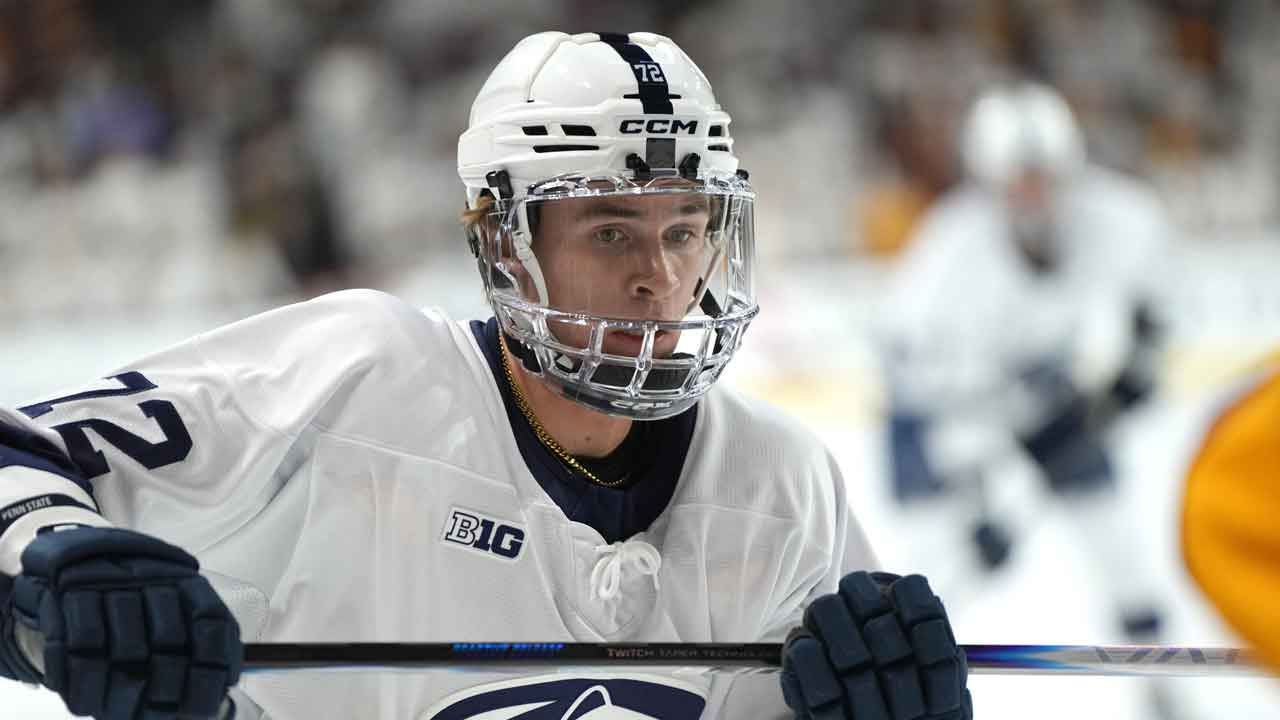
No. 1: Gavin McKenna, LW, 5-foot-11, 170 pounds, Penn St. (NCAA)
The race for No. 1 has been tight all season long and getting to see McKenna up close and personal at the NHL Combine was enough to convince me that he is the top prospect available in this draft class.
Everyone is familiar with his game as the most gifted, creative and talented offensive player in this class. He looks like he’s taken the time from the end of the season to work on his physical strength and conditioning as evidenced by a top-10 showing in four of the 15 and a top-25 showing in eight of 15 combine tests. Aside from that, in the interview process he was forthcoming and understands what needs to be done to play regularly at the next level.
No. 2: Ivar Stenberg, LW 5-foot-11, 183 pounds, Frolunda (SHL)
A reliable player in all situations, Stenberg projects to produce top-level offence. He competes off the puck and is willing and able to play defensively as well. Stenberg works well along the wall, and he has the ability to change the pace of the game with sharp cutbacks and capable acceleration. He’s a playmaker, but can operate at the net front and score from mid range with ease. Stenberg has proven to be an adaptable player whose game doesn’t change regardless of the size, strength and age of competition. He has a chance to play in the NHL next year.
No. 3: Chase Reid, RD, 6-foot-2, 195 pounds, Sault Ste. Marie Greyhounds (OHL)
Reid possesses some Cale Makar-like qualities with elite skating and edgework. He may be the best skater of this group. He passes the puck swiftly, accurately and with NHL pace. He also possesses a bomb of a shot and projects to run a PP1 in the NHL. From a character perspective, he has overcome adversity and has consistently answered the bell when more responsibility has been placed upon him. It will be fun to see if his developmental pattern remains steep at Michigan State. He may be the defenceman equivalent to Porter Martone by the end of next season.
No. 4: Caleb Malhotra, C, 6-foot-1, 182 pounds, Brantford Bulldogs (OHL)
The best all-around centre this draft class has to offer. Malhotra has hit a number of benchmarks along the way from a brilliant BCHL playoff run in his draft minus-one year, through earning his spot in the top-six on a deep Brantford team. He was named captain of the CHL team in the CHL/USA Prospects challenge in November, and was its best player. Malhotra thinks the game well and is consistently on the right side of the puck, or putting pucks in areas to keep his team out of danger. His 13-goal, 26-point playoff performance ranked fourth amongst all players, giving confidence to teams that he can provide offence when things are most difficult.
No. 5: Carson Carels, LD, 6-foot-1, 198 pounds, Prince George Cougars (WHL)
From the second you meet him, Carels inspires confidence. Coaches feel the same way in that he can be trusted in any situation. Carels excels in every facet of the game. He makes good, smart decisions with the puck, putting others in position to make plays, or making plays himself to get pucks to the interior. He defends vigorously by getting into the opponents’ hands or using his strength to body the opposition out of position. He experienced a major uptick in point production this season going from six goals and 35 points to 20 goals and 73 points in two fewer games. Like Brady Martin last year, Carels will opt out of attending the draft in Buffalo, and will instead take care of things on the ranch at home in Manitoba.
No. 6: Viggo Bjorck, RW, 5-foot-9, 177 pounds, Djurgardens (SHL)
Upon meeting Bjorck at the NHL Combine, he presented just a little taller and a little thicker than I envisioned him. From a pure interview perspective, he was confident not cocky, easy to speak to, and engaged in the conversation. He conveyed that he is not at all concerned about his size being an issue moving forward. His world juniors performance was epic, although overshadowed by Stenberg. In similar fashion, Bjork played top minutes and PP1 for Sweden’s men’s national team, yet Stenberg got all the love for producing a slightly higher point total. His numbers at both the U18 and U20 levels jump off the page. Bjorck is a tireless worker, constantly calculating the game and working ahead of his opponents. He doesn’t shy away from anything.
No. 7: Keaton Verhoeff, RD, 6-foot-3, 212 pounds, U. North Dakota (NCAA)
Came to the NHL Combine with a chip on his shoulder, willing to prove in-person that he was worth the hype that saw him as the draft’s top player earlier in the season. With a number of other elite defencemen at the top of this class, and at least two of them right shots, Verhoeff hasn’t taken a step back, but others have pushed forward to challenge him. As my colleague Jason Bukala reminds me, the NCAA game is not easy. And it’s really not easy when you’re a young freshman who eats minutes and defends against, bigger, older, faster competition daily. I can’t help but think about Drew Doughty, John Carlson, Aaron Ekblad and Cale Makar as right-shot defencemen with size, offensive acumen and the ability to defend. Verhoeff brings all of those elements to the table. The question is, will he produce at Doughty or Ekblad levels?
No. 8: Daxon Rudolph, RD, 6-foot-2, 206 pounds, Prince Albert Raiders (WHL)
Provided elite-level offence with a 28-goal, 78-point regular season and an additional 27 points in 19 playoff games while leading his team to the WHL final. A former first overall pick in the WHL bantam draft, Rudolph will continue his development at Denver University under the watchful eye of David Carle. He has the mobility to make plays off the blue line and the smarts to evade coverage in the offensive zone. Rudolph can transport pucks, while recognizing when to move it, making him an effective transitional player. He will use his size and has a nasty side to his game. Ironing out some defensive zone detail and managing his physical game will be keys moving forward.
No. 9: Alberts Smits, LD, 6-foot-3, 205 pounds, Munchen (DEL)
The past 16 months have been wild for this guy. He’s played for his country in U18, U20, Men’s Senior tournaments and at the Olympic Games. He’s also played with and against men in the best professional leagues in both Finland and Germany. He played a large role on each of those teams, often being utilized in a top-pairing role. He capped the season as the EJ McGuire award winner given annually to the draft prospect “who best exemplifies commitment to excellence through strength of character, competitiveness, and athleticism.” Smits is the most NHL-ready player available in the draft class.
No. 10: Ethan Belchetz, LW, 6-foot-5, 228 pounds, Windsor Spitfires (OHL)
A collarbone injury to Belchetz left scouts short of playoff and ultimately U18 viewings. Over the course of his recovery, he has focused on nutrition and strength building and has become more lean. Not that he needed to, but his muscle distribution is different than where it was at the start of the season. No question he is a power forward with a mean streak who will play at the next level once he completely fills-out. Belchetz has a big league shot, a big-league body and big-league nastiness.
He has really good hands, can score from distance and at the net-front. With added quickness, especially off the mark, and continued development at Michigan State, Belchetz will be highly sought after and is a top-10 player despite just over point-per-game numbers. Finding consistency in his game, be it through scoring or impacting in other ways, is his key to moving forward.
No. 11: Malte Gustafsson, LD, 6-foot-4, 201 pounds, HV71 (SHL)
Left a great lasting impression on scouts with his smart two-way play at the U18s, where he wore an ‘A’ and had five points in six games. His poise and calmness under pressure make him an attractive prospect. He has good feet and can sneak up on opponents with excellent lateral movement, agility and a long reach. He uses his skating to take away time and space both in the neutral zone and defending inside his own zone. He seems to be more of an offensive threat when playing on the national team, but there’s little scoring in his profile otherwise.
He is the type of player who will excel playing with older, more experienced players. He adapted well to the SHL level and that same type of adaptation is expected at the next level. He is at the start of my second tier of defencemen and a player I can see steadily improving his offensive numbers to project secondary offence and second-pairing potential.
No. 12: Wyatt Cullen, LW, 6-foot-1, 176 pounds, USNTDP (USHL)
His growth spurt has resulted in a rise up draft boards. He entered the USNTDP program at the start of last season at just 5-foot-8 and under 150 pounds, but his most recent measurement at the Combine was 6-foot-1, 176 pounds. Ironically, he missed the early part of the season due to a growth-related injury. Once through that, however, he showed a dynamic side to his game as one of the best puck-handlers in the draft class.
He’s got great feet and accelerates like a rocket. When you add in he has NHL bloodlines from a warrior of a three-time Stanley Cup champion (Matt), Wyatt lifts comfortably inside the first half of this draft. From an offensive output standpoint he left a lasting impression with nine points for the US at the U18s as their only point-per-game player.
No. 13: Alexander Command, C, 6-foot, 186 pounds, Orebro (Sweden J20)
Command has been gaining steady momentum since Christmas. He started the season having been cut from the Hlinka-Gretzky team and worked through it to play well enough to earn six SHL games. Admittedly, he got away from his game upon returning from his SHL stints, but was smart enough to realize he needed to get back to his strengths in order to be successful. In both the WJAC and the U18 worlds, he worked his way through the lineup, earning more minutes to become a trusted player, while also putting up point-per-game numbers in events where Sweden earned bronze and gold respectively.
Because of his hard, honest style of game and determination to win, he will benefit more from the Carolina Hurricanes winning the Cup than any other prospect in the class. He is a player coaches will love because of his work ethic, determination and reliability.
No. 14: Tynan Lawrence, C, 6-foot, 185 pounds, Boston University (NCAA)
Many feel that his mid-season jump to the NCAA — especially coming off injury — was a questionable move at best. He will be criticized for his lack of production (two goals, seven points in 18 games), but then again, maybe the expectations were too high for one of just five 17-year-olds in college hockey. There are others who say he was playing the game the right way in the NCAA, got chances and was just snake-bitten.
His draft slot and potential will be debated heavily because he plays a premium position in a draft class devoid of high-end centres. He also has had plenty of previous success including a playoff MVP performance for USHL Muskegon in his draft minus-one season and a number of productive international appearances. The one that may define his draft position is the most recent U18 worlds, where his six points in five games were second-best for Canada.
No. 15: Ryan Lin, RD, 5-foot-11, 178 pounds, Vancouver Giants (WHL)
Another polarizing figure, especially coming off a 2025 draft that didn’t see one defenceman under 6-foot taken. Lin is extremely mobile and moves well, using different deceptive tactics to avoid oncoming forecheckers. Some of that also works for him in the offensive zone. He competes hard and gaps up well. He had a late-season injury, but recovered in time to get nine tune-up games with Vancouver before heading over to the U18s. In that event, he showed more physicality. Lin is willing and able to be consistently part of the rush. Internationally, he has been a key contributor in a number of events, including two U18 worlds, one of which was a gold medal win. Like Daxon Rudolph, Lin will go to Denver to continue his development.
No. 16: Elton Hermansson, RW, 6-foot-3, 181 pounds, Modo (Allsvenskan)
Had great bookends to the season while playing with his peers. He kicked off the year with 11 points in five Hlinka-Gretzky games and ended the season with a strong showing at the U18s where he put up 12 points in seven games en route to a gold medal and a top player award. He is a good-sized winger with a goal-scoring acumen. Hermansson was moved up to the Allsvenskan mid-season and still showed he was able to contribute offensively. His 11 goals topped all 17-year-old players in the Allsvenskan.
No. 17: Oscar Hemming, LW, 6-foot-3, 193 pounds, Boston College (NCAA)
Missed out on half a season while his representatives worked through a contractual dispute in his native Finland. When the impasse stalemated, Hemming changed course and moved on from trying to play for OHL Kitchener, and instead made his way to Boston College. With his size and bulldog mentality, he was more than able to display the physical element in his game, one which he fully embraces.
It’s hard to extrapolate what his offence will look like at the next level as he had only 19 games of college hockey, where he collected eight points. He does have some scoring in his profile and he does have the benefit from his dad being a former pro player, and his brother, Emil, being a first-round NHL Draft pick.
No. 18: Nikita Klepov, RW, 5-foot-11, 178 pounds, Saginaw Spirit (OHL)
Entering the OHL as a 17-year-old rookie, no one was sure what was going to become of Klepov. He had 31 points in 59 USHL games last season before moving to Saginaw. By the end of this season, Klepov became the first OHL rookie to lead the league in points (97) since Patrick Kane in 2007. He tripled his goal and point totals in a more skilled league.
Klepov projects to provide top six offence with a special talent to be effective on the power play. He started the season with a well-rounded game, got a little too point happy, and by the end of the year was back playing more responsibly again. Klepov is a creative player who protects pucks well. He has elite vision and is open to hard coaching.
No. 19: Adam Novotny, LW, 6-foot-1, 204 pounds, Peterborough Petes (OHL)
A fine skater who plays a pro-style game, Novotny is another player who endears himself to teammates and coaches. He consciously made the decision to turn down pro money at home to come to North America to learn the game on the smaller ice surface. His body type, skill set and attitude made the transition seamless. He is more than happy to hunt pucks, lay the body and take advantage of every shooting opportunity. He adapted to a slightly different role at the world juniors, offering a more responsible game keyed on forechecking and playing responsibly above the puck. He’s the type of player you want on the ice when the games become more difficult.
No. 20: J.P. Hurlbert, LW, 5-foot-11, 183 pounds, Kamloops Blazers (WHL)
Since arriving in Kamloops, Hurlbert has added 10 pounds and almost an inch of height. His upper body mass was noticeably different at the NHL Combine from when I last met with him in November. More impressively, he showed up in a suit, and traveled with enough suits to cover off all of his team and media interviews. That is a rarity, but a small detail that tells me a lot about how he represents himself, his family and the Blazers organization. Further, it tells me that he treats his craft like a job.
From an on-ice perspective, he competes on and off puck and can make plays, but he loves shooting the puck and he’s good at it, scoring 42 goals on 294 shots this season. His path to this point is somewhat unusual but may become the norm, having left the USNTDP at 17 to play in the WHL.
No. 21. Ilia Morozov, C, 6-foot-3, 200 pounds, Miami (NCAA)
Scouts love players who improve day-over-day in their draft eligible seasons. Morozov did that, and it’s a difficult task as one of the youngest players in the draft, playing in the older, harder NCAA ranks. Physically, he does not look like a younger player. He’s broad-shouldered, strong as an ox and is skilled enough to make plays and rip pucks. He moves well in open ice and does a good job using his size and strength to protect the puck, shield defenders, and give himself a little more time and space to make plays and find teammates. He endears himself to coaches and teammates alike with an undying commitment to working at his game and improving.
No. 22: Maddox Dagenais, C, 6-foot-4, 196 pounds, Quebec Remparts (QMJHL)
If a team believes he can play centre, the positional bias will result in him being selected higher than this ranking. Dagenais is a confident young man with NHL bloodlines. On-ice, it took him the better part of the first half to understand he could regularly impact the game without scoring and utilizing his physicality. The turning point was the CHL/USA Prospects Challenge, where he finished every hit, hustled to loose pucks, was a menace on the forecheck, and chipped in with an assist. Aside from that, he’s got a pro shot with power and accuracy. He is a volume shooter. Dagenais has plenty of room to add strength and muscle to an already impressive frame. I think there’s some Todd Bertuzzi in him.
No. 23: Tommy Bleyl, RD, 5-foot-11, 165 pounds, Moncton Wildcats (QMJHL)
There’s a lot of Lane Hutson in his game, size included. Bleyl is an extremely confident puck transporter/mover, who excels in a number of areas of the offensive game. He’s an elite skater in all directions. He’s got great stick skills and deception that work well at high speed. His development this year has been stunning, considering he spent his draft minus-one year in prep school. He led the QMJHL in assists with 68 and out-paced the next-closest rookie defenceman by 37 points. Defending the rush, and cutting plays in neutral ice are his strengths. He will have to adapt his game to defending bigger, stronger bodies and will get a chance to do that in his next stop at Michigan State. I believe he will be a PP1 quarterback at the NHL level.
No. 24: William Hakansson, LD, 6-foot-4, 207 pounds, Lulea (SHL)
There’s plenty of value in a young player who knows his identity. Hakansson is that guy. He fully understands that his best assets lean heavily to the defensive side of the game. He’s a hard, not necessarily heavy player, who uses his body well to defend the net front. He leans on opponents to dislodge pucks, but also has the necessary puck skills to begin transition. He’s the type of player you can see rounding out his game and adding some secondary production down the road. In the meantime, he’s happy to play to his strengths.
No. 25: Oliver Suvanto, C, 6-foot-2, 207 pounds, Tappara (Liiga)
There are so many things to like about this player. He’s still very young and raw and despite playing a pro-style game, I believe it will take some time for him to arrive at the NHL level. His birthday is two weeks shy of him being eligible for next year’s draft instead, yet he spent the season playing against professionals in Liiga. Understandably, he struggled to produce, despite getting middle six minutes. While he showed a slight uptick in production when getting back against his peer group, his numbers are underwhelming and that is concerning.
Suvanto tested well at the combine and already possesses a pro body. He can work the corners, ward-off defenders and protect the puck extremely well. His skills translate well to fit a cycle team, but there are fewer and fewer of those in the NHL every year. He may go higher than this ranking suggests, especially if a team feels there is some unearthed offence in his projection.
No. 26: Xavier Villeneuve, LD, 5-foot-11, 162 pounds, Blainville-Boisbriand Armada (QMJHL)
As a sub 6-foot defender, Villeneuve uses his motor and high compete to work through size issues. He is a leader on the ice and is guilty of taking matters into his own hands on occasion. He gets around the ice with speed, quickness and has a zesty side to his game. He’s had good numbers in the QMJHL, but will it translate to the next level? If a team doesn’t project that, can they still see enough defence to take a high-compete guy who can play bottom-six minutes regularly?
No. 27: Simas Ignatavicius, RW, 6-foot-3, 198 pounds, Geneva (SUI)
He has been laser-focused on becoming an NHL player since he could talk. I like the fact that at an early age, he moved away from home to pursue more competitive hockey. He has lived on his own, learned multiple languages, and basically been an adult since he became a teenager. Ignatavicius stuck to his guns and stayed in Switzerland to play pro during his draft year, and it worked. He put up 20 goals and 40 points in 29 games playing for coach Ville Peltonen.
Ignatavicius is an interesting sort in that he idolizes Patrick Kane, but wants to pattern his game after Matthew Tkachuk. He has a chance to be the highest drafted Lithuanian ever taken into the NHL. He comes from an athletic family, with a dad who played pro basketball and a mother who played handball. He has embraced an underdog mentality and is determined to see that through this draft.
No. 28: Nikita Shcherbakov, LD, 6-foot-5, 187 pounds, Ufa (Russia)
A real enigma in this draft class. It would’ve been perfect had he been able to make it to North America to play in the junior ranks. If he’d have been able to do that, he might’ve looked a lot like Nikita Zadorov who went 16th overall to Buffalo in the 2013 draft, and is now a force and someone who has played over 800 NHL games.
Shcherbakov doesn’t yet exhibit the type of bite Zadorov plays with. Instead, he is a smooth skater who displays power in his stride and he handles the puck very well for a player his size. He’s effective at being a part of the rush, but also makes plays in his own zone to initiate the rush. He transitioned from the MHL to the VHL in Russia and while his production took a small step backwards, he maintained quality minutes. I can’t speak to his character, but from a hockey perspective, there are a number of teams that would take him.
No. 29: Egor Shilov, C, 6-foot, 177 pounds, Victoriaville Tigres (QMJHL)
He has top-10 skill that should make him a much higher-ranked player, but there is concern about his play away from the puck, defensive play overall and a consistent compete level. On the plus side, Shilov has lightning quick hands and small area escapability. His vision is elite and those who play with him have to be ready to receive the puck anywhere, at anytime.
When engaged, he also works well along the wall and protecting the puck. Like Klepov, Shilov spent last year in the USHL. He nearly tripled both his point and goal totals, leading all QMJHL rookies with 82 points. In order to take advantage of that elite skill, a team is going to need a strong mentor in player development and strong leadership in the room to hold him to consistently high standards.
No. 30: Tobias Trejbal, G, 6-foot-4, 190 pounds, Youngstown (USHL)
An interesting study no doubt. Trejbal commands a room with his size, style and smile. He meets all NHL teams’ height requirement for the position, and although goalies tend to be lean, there’s still enough room on his frame to add a little weight and a lot of strength, without sacrificing athleticism. His best trait is the calmness he brings to a game. He’s prepared, poised and efficient. He’s calculating in how he goes about his business, preparing meticulously not just through stretching, but through studying his opponent as well. This calmness permeates throughout the team. Technically, he’s very sound. Trejbal moves well and stays square to the puck. He absorbs pucks and the ones he can’t contain he has purpose in directing them out of harm’s way. I have him as the first goalie off the board, likely to be taken by a team with multiple first-rounders.
No. 31: Maksim Sokolovskii, LD, 6-foot-7, 238 pounds, London Knights (OHL)
The size and sheer upside of this player will see a team take a flyer this late in the first round. The added comfort of a player coming out of the London Knights program will also play a part here.
No. 32: Liam Ruck, RW, 5-foot-11, 187 pounds/Markus Ruck, C, 5-foot-11, 167 pounds, Medicine Hat Tigers (WHL)
As twins who have spent less than a week away from one another their entire lives, I truly believe these brothers need to be drafted together to maximize their talents. That will be a tall order as a lot of things have to fall right for this to happen.
There will be a number of teams who believe a split will benefit both players. They did greatly benefit from the departures of Gavin McKenna and Cayden Lindstrom from Medicine Hat, and took full advantage of the minutes-void left in the lineup.
Liam is the right-shot shooter who improved from 25 goals and 41 points to 45 goals and 104 points this season. Markus is the left-shot playmaker who went from eight goals and 21 assists to an astounding 21 goals and 87 assists for 108 points, good enough to lead the WHL.
Both players will need a couple of years to mature physically. Their dad, Derek, also played in the WHL and he stands 6-foot-3 and weighs over 200 pounds.
