Story Highlights
- The live price of the Cardano token is Loading live price .
- Cardano price could see a potential upside toward $5.00 by the end of 2026.
- ADA’s long-term expansion scenario points toward $350.00 by 2030.
Cardano (ADA), one of the most research-driven Layer-1 blockchains, is now entering a critical phase of execution after years of development-focused growth. While its earlier roadmap emphasized peer-reviewed innovation and network stability, the current cycle is increasingly centered around scalability, real-world utility, and ecosystem expansion.
The ongoing evolution of Cardano is being shaped by major upgrades, including the introduction of privacy-focused infrastructure through Midnight and scalability advancements targeting significantly higher throughput. These developments are positioning the network to compete more aggressively with leading smart contract platforms, particularly in areas such as DeFi, enterprise applications, and regulated use cases.
As the network transitions into this execution-driven phase, the key question for 2026 is whether these technological advancements can translate into sustained adoption and capital inflows. With fundamentals strengthening beneath the surface, Cardano’s next move may depend on how effectively it converts innovation into measurable network growth and price momentum.
This article delves into Cardano’s 2026 outlook and long-term price prediction, analyzing whether these catalysts can translate into a sustained breakout. Explore this Cardano price prediction 2026 and beyond, filled with expert insights and ambitious forecasts.

Cardano Price Today
Recent ADA News and Catalysts
Cardano’s recent developments point to a shift from roadmap delivery to early-stage execution.
Midnight airdrop anticipation grows:
Community attention remains focused on the upcoming Midnight ecosystem rollout and token distribution plans.
Whales continue accumulating near support:
Large holders have been steadily adding ADA during the recent correction phase around key demand zones.
Hydra scaling progress advances:
Development around Hydra and Cardano’s Layer-2 infrastructure continues supporting long-term network scalability.
Treasury and governance transition gains traction:
Cardano’s decentralized governance framework is moving deeper into implementation, expanding ecosystem participation.
Cardano (ADA) June Price Prediction 2026
Cardano’s June story has shifted from consolidation to defense. After losing the long-held $0.18-$0.20 support region earlier this month, ADA has spent the past two weeks trying to stabilize near fresh cycle lows around $0.16. The aggressive selling seen in early June has cooled, but buyers have yet to deliver a convincing recovery that would signal a broader trend reversal. ADA remains trapped beneath its descending trendline and key moving averages, keeping the broader structure tilted in favor of sellers. Still, the fact that price continues to hold above the $0.15 demand zone suggests the market may be entering an accumulation phase rather than another capitulation event.
For the remainder of June, the $0.18-$0.20 range remains the key battleground. A recovery above this area could trigger a move toward $0.22 and potentially $0.25. However, if ADA loses the $0.15 support floor, downside pressure could extend toward the next demand region near $0.13.
Coinpedia’s Cardano (ADA) Price Prediction 2026
Cardano’s price outlook for 2026 is increasingly shaped by a transition phase, where prolonged weakness is giving way to a more stable and controlled structure. After months of consistent lower highs, ADA has started to hold firm around the $0.24–$0.25 zone, suggesting that selling pressure is no longer as dominant as before, even as activity across the ecosystem continues to build gradually in the background.
The key challenge remains the $0.45–$0.60 range, which has repeatedly acted as a barrier during past recovery attempts. This zone now carries added significance, as it coincides with a phase where improving network activity, ongoing development upgrades, and a broader shift in market sentiment toward altcoins are beginning to align with price structure.
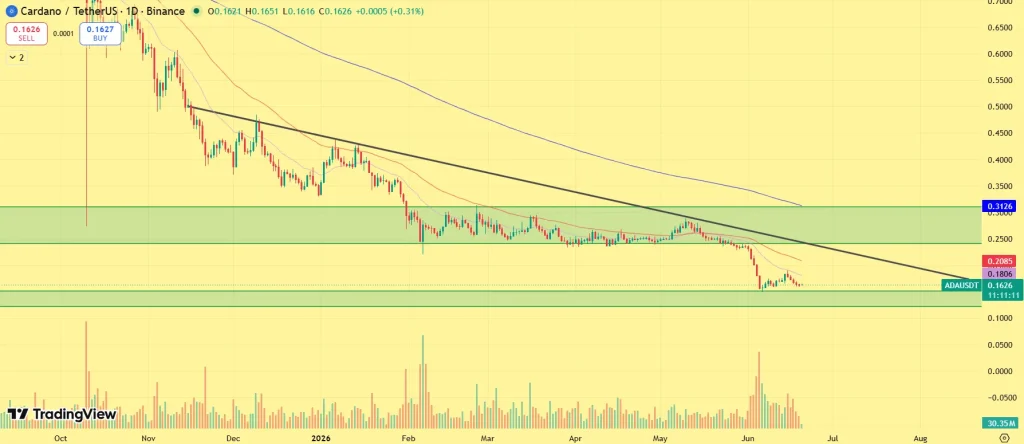
A sustained move above this range would signal a clear shift in trend, allowing ADA to move beyond consolidation and enter a more defined recovery phase. In such a scenario, the price could gradually expand toward the $1.20–$2.20 range through 2026, supported not only by structural improvement but also by increasing participation and capital rotation within the market.
At the same time, failure to reclaim this resistance may extend the current range-bound phase. Even then, the consistent defense of lower levels, combined with steady ecosystem progress, suggests that downside risk remains limited, with the market continuing to build a base over time.
Overall, Cardano is no longer in a declining phase, it is positioned just below a critical resistance zone, where both structure and underlying momentum are beginning to align, and how it reacts here will ultimately define its 2026 trajectory.
Cardano On-Chain Analysis
Cardano’s on-chain metrics are beginning to align toward a constructive setup, suggesting that underlying conditions may be improving ahead of a broader price expansion phase. The MVRV Ratio (30D) remains in negative territory, indicating that a large portion of holders are currently below their cost basis. From a market structure standpoint, this phase has historically coincided with accumulation zones, where downside risk tends to compress and long-term investors gradually increase exposure.
At the same time, development activity continues to hold steady, reflecting sustained builder engagement despite muted price performance. This consistency reinforces confidence in Cardano’s long-term roadmap, particularly as key upgrades move closer to implementation.
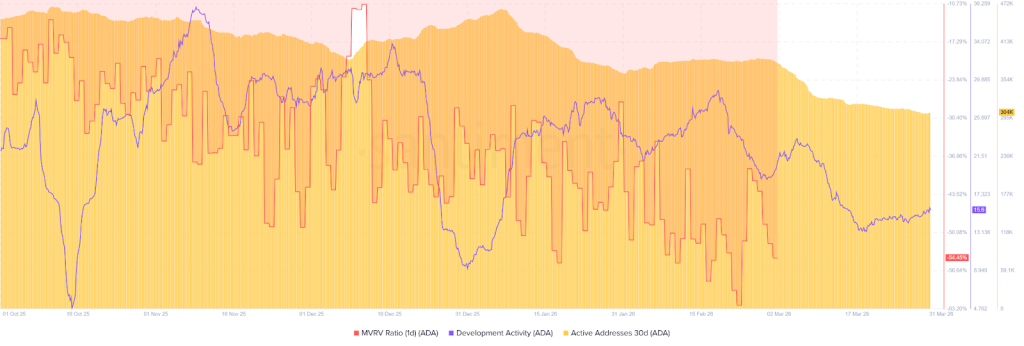
While active addresses (30D) have softened in recent weeks, this can be interpreted within the context of a consolidation phase rather than structural weakness. Periods of reduced activity often precede renewed participation, especially when supported by improving fundamentals and upcoming catalysts.
The combination of undervalued conditions (MVRV), consistent development momentum, and stabilizing network activity suggests that Cardano may be transitioning into an early-stage accumulation phase ahead of potential expansion.
Rather than signaling weakness, current on-chain conditions point toward quiet capital positioning and foundational strength, with the potential for demand to reaccelerate as catalysts begin to translate into real network activity.
Cardano (ADA) Price Prediction 2026 – 2030
This table, based on historical movements, shows ADA prices to reach $10.25 by 2030 based on compounding market cap each year. This table provides a framework for understanding the potential Cardano price movements. Yet, the actual price will depend on a combination of market dynamics, investor behavior, and external factors influencing the cryptocurrency landscape.
Cardano Price Prediction 2031, 2032, 2033, 2040, 2050
Based on the historic market sentiments and trend analysis of the altcoin, here are the possible Cardano price targets for the longer time frames.
Never Miss a Beat in the Crypto World!
Stay ahead with breaking news, expert analysis, and real-time updates on the latest trends in Bitcoin, altcoins, DeFi, NFTs, and more.
FAQs
Cardano could trade between $2.75 and $3.25 in 2026, with an average near $3. If bullish momentum strengthens, some forecasts see ADA potentially reaching $4.50.
Cardano could trade between $9.00 and $10.25 by 2030, with an average near $9.75 if adoption grows and the broader crypto market continues expanding.
Long-term projections suggest Cardano could reach up to $70 by 2040 if blockchain adoption accelerates and ADA maintains strong ecosystem growth.
Some long-term models estimate ADA could reach around $200 on average and up to $350 by 2050, depending on global adoption and market maturity.
Cardano is considered a long-term project due to its research-driven development, scalability upgrades, and focus on decentralization.
ETF approval, institutional adoption, network upgrades, and improved macro conditions could all positively impact ADA’s price.
