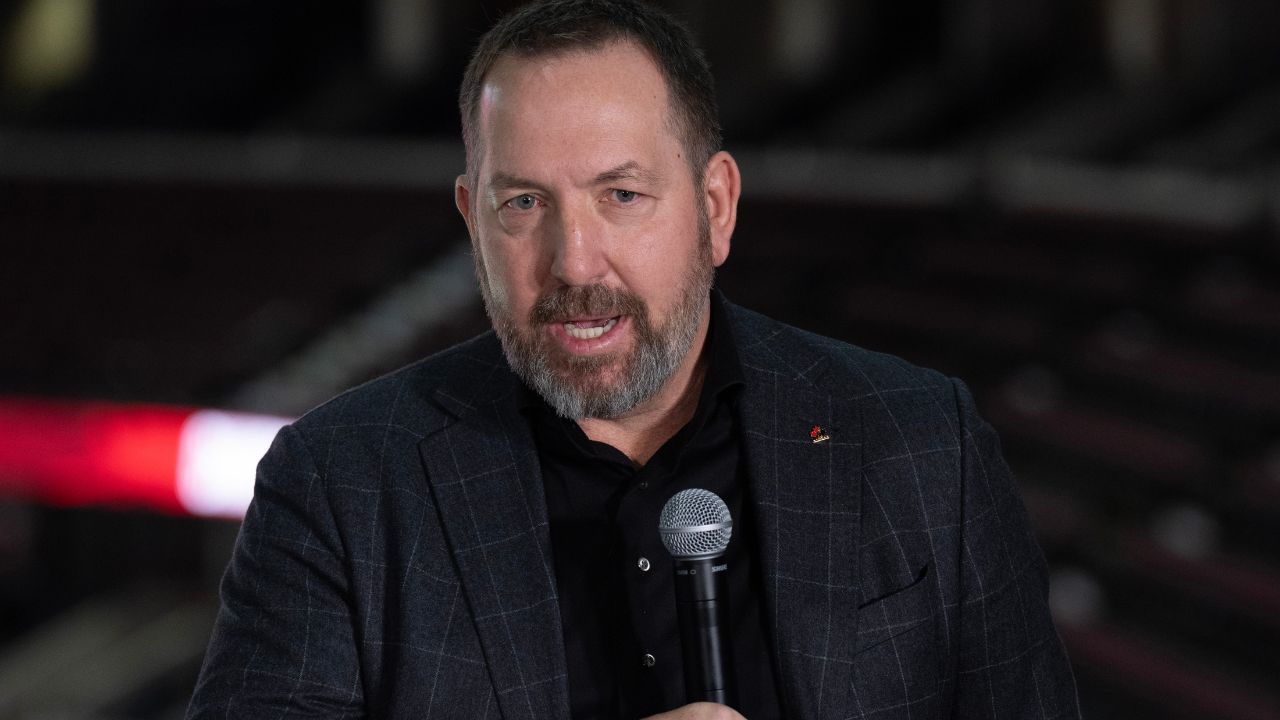
In his role as senior vice-president of high performance and hockey operations for Hockey Canada, Scott Salmond oversees all levels of the sport in the country.
The junior men’s side, of course, has seen dramatic change with the NCAA opening the door to CHL players. On the international front, meanwhile, Canada is in a bit of a gold drought at the junior and under-18 levels.
Summer is the time when Hockey Canada gathers its top players for under-17 camp (this past week in Oakville, Ont.), the World Junior Showcase exhibition tournament (next week in Windsor, Ont.) and the Hlinka Gretzky Cup under-18 tourney (next month in Edmonton).
With the calendar getting busy, Sportsnet caught up with Salmond recently to discuss a variety of topics related to junior hockey.
(The interview has been edited slightly for brevity and clarity)
Sportsnet: There’s been talk in hockey circles wondering whether the CHL could go independent from Hockey Canada, though CHL leaders haven’t said they’re looking at that. How do you view Hockey Canada’s relationship with the CHL right now?
Salmond: I think it’s strong. I think we’re in the unique position where, without question in my mind, the CHL is our biggest and best partner. They develop our players on the male side. They’re in communities across our country, and they’ve been a great partner.
How does that partnership evolve? Certainly, there’s more American players playing in the CHL, there’s more European players playing in the CHL. But I think you can look at it two ways. You can say, well, that’s opportunities that are being taken away from Canadians, or you can say it’s an opportunity to ensure the best Canadians are playing against the best competition in the world and therefore developing at a higher rate. I choose to look at it that way. I think eventually, through expansion, and there’s so much great junior-A hockey across Canada, it’s going to find its level.
But in terms of the partnership, I’m really interested in the CHL and how they invest in Canadians. I understand them wanting to be the best development league in the world … But I also realize they’re our partner, and together we need to invest in development, particularly of elite players. I think we’ve had great conversations around that. I think there’s an opportunity for us to strengthen our relationship and really double down on the development of Canadians.
It’s unique because at the same time, I think there’s a level of protectionism really around the world. The U.S. wants the U.S. players to stay there; I get that. Europeans want their players to stay there and develop. At the end of the day, I think it’s all of our responsibility to ensure that players have choice and they’re going to where they believe is best for their development.
Sportsnet: You said you like the best competition in the CHL. When a team like Moncton, which has been one of the stronger teams the past two years, has something like nine, 10 or 11 Americans, is that a concern?
Salmond: I think there’s still going to be a time where it finds its level. I like the idea of 80 per cent of the Canadian Hockey League being Canadians, whether that means there’s 12 in Moncton and none in Cape Breton. I’m not sure that the amount of players on each team matters as much as the overall product and the opportunity for Canadians to play.
Would I like to see more Canadians on those teams and less non-Canadians? Sure. But I also understand the CHL is in the business of developing players and in the business of winning, so that means you’re trying to get the best players.
Sportsnet: The NCAA pretty much can take whichever players it wants (assuming they meet NCAA eligibility) without worrying nearly as much about international transfer agreements, whereas for the CHL, it’s much more of an issue. Do you understand that challenge?
Salmond: “I completely understand it. We have a great relationship with USA Hockey, and they’ll tell you over and over again, they’re a college-bound country, they develop players for college. I would say we’re a CHL-bound country; we develop players on the men’s side for the Canadian Hockey League.
Their biggest partner operates without constraints, which I think is a real challenge to the system. Not just the CHL, but the system in general. You just have to look at the Finnish player (Oscar Hemming) who ended up in the NCAA this year, wanted to go to Kitchener, couldn’t go there, and so, without restriction, ended up in the NCAA (before being picked in the first round of the NHL Draft by the Columbus Blue Jackets out of Boston College). That’s a challenge, and I don’t think the NCAA will change.
I think the CHL’s desire to operate within the system but with less constraints, first of all, I think it’s admirable in a way. I think they could just say we’re just going to step outside the system, this is going to be the wild west, and we’re going to take players from wherever we want. I don’t think that’s really actually good for anyone. I think they’re trying to find a way to remain in the system, continue to work with us, continue to work with the IIHF on international transfers, with USA Hockey on U.S. transfers.
It’s not easy because I don’t think at the end there’s any winners in terms of protectionism of players, and there shouldn’t be. Players should have the choice to go where they want, but within reason. There should be structure, there should be compensation, and it should be regulated. I think the CHL has done great work in that regard. I think we’ve tried to help them. It’s not done, but I think there’s a way it will get done.
Sportsnet: When you see a Landon DuPont go to the NCAA at 17, are you fine with that, or would you like to keep Canadians in the CHL longer?
Salmond: We have a Canadian development model. I’d like to see Canadians develop within our system, within our structure. I understand free choice, I understand player movement. I get all those things. At the end of the day, if Landon and his family believe that that’s the best place for him to develop, particularly with his situation where he started (one year) earlier in the CHL as an exceptional player, and he feels he’s best served there now, I get it.
If players are leaving for reasons other than development, I’d love to find a way to keep them in Canada. But again, I respect a player and a family’s choice to play where they feel they’re going to get the best opportunity to develop.
Sportsnet: In terms of the world juniors, you’ve been three years now without a gold. Is that concerning, and how do you feel about where you’re at?
Salmond: I’m disappointed, and I am concerned. At the same time, I am realistic. I think last year we had seven (eligible) players in the National Hockey League, and other countries had none. That’s an excuse in a sense, but when you take seven players who are NHL players off your roster, it becomes more difficult to win.
Have we done it in the past? Yeah. Do I think we have depth in our country and that we should still be able to play in the gold-medal game and win? Yeah, I do. I think we’ve taken great steps by hiring a full-time general manager (Alan Millar), and for the first time ever, we have a full-time coach in Misha Donskov who will lead that program. I think the margin for error is so razor-thin between winning and losing that you need to try to have every advantage you can.
Whether that’s coaching or managing or more support through the CHL or otherwise, that’s what we need. We’ve really kind of doubled down looking at all areas — goaltending, player recruitment, player evaluation, coaching. We need to get back to where we want to be, and that’s with a gold medal.
Again, I look at our depth chart this year, and there’s players who will be in the National Hockey League, which will challenge us. But I think there’s an opportunity for us to also have players who could be in the American Hockey League, in college, and the CHL, which will be really the first time we’ve got players in four different places on the national junior team (with the NHL being the potential fourth place).
So the landscape continues to change, but our objective is the same. Yeah, I’m concerned, but we’re not just waiting. We’re working hard to try to find some solutions here.
Sportsnet: In terms of goalies, it hasn’t been as strong a position (at the pro level for Canadians) in recent years at is has in the past? Are there things you can do in that regard?
Salmond: Absolutely, 100 per cent. We’re working on hiring a full-time manager of goaltending for Hockey Canada, from men’s and women’s to development. We’ve had great goaltending coaches in the past who have worked for us, but haven’t really been able to find an individual who connects the dots from men’s to women’s to what I call next-gen development. Kind of that aspiring high performer from 11 or 13 until the time they enter our national teams.
Someone who can really connect the dots between all those programs, have some consistency and foundation for our goaltending in Canada. Help us in identifying goalies, help us in (finding) goaltending coaches, and really building a foundation for our program.
I’m super excited about that. I think we’re close to having something like that in place. I think that’s potentially a game-changer for Canadian goaltending.
