
Here’s what sets us contrarians apart from the herd: We know that every crazy headline that comes across our phones is great news for us.
We welcome the madness and volatility because it lets us buy dips in our favorite dividend growers! Plus, we have an overlooked edge the crowd is clueless about: Our “Dividend Magnet” system for picking dividends that are soaring–and taking their share prices along for the ride.
I’d go so far as to say a soaring dividend is the biggest driver of share-price growth.
When many investors think of growth, they think of aggressive non-payers like Netflix (NFLX), Shopify (SHOP), Tesla (TSLA) or (heaven forbid!), Space Exploration Technologies Corp. (SPCX), the latest media darling. But take a look at this:
A Dividend Magnet “Classic” Skyrockets in the Long Run …
In purple, we’ve got the share-price performance of Texas Instruments (TXN) over the last 10 years. Next to that, we have its stair-stepping dividend (in orange). You can clearly see the payout pacing the stock higher, resulting in a 314% price gain.
Reinvest those payouts and you’re doing even better: a 441% total return over that decade. And that’s from a very well-established stock (TXN traces its roots back to 1930). No shiny growth pony here.
I mention TXN because it gives us a clear snapshot of just how effective this strategy is. When we held the stock in our Hidden Yields dividend-growth service from June 2017 to January 2022, we walked away with a “payout-powered” 148% total return.
TXN has delivered for us in the short run, too. We held it for three weeks (!), from April 16, 2026, to May 7, 2026, in my Dividend Swing Trader service, neatly capturing a chunk of that spike in the chart above. The result? a nearly instant 28.5% return.
… And the Short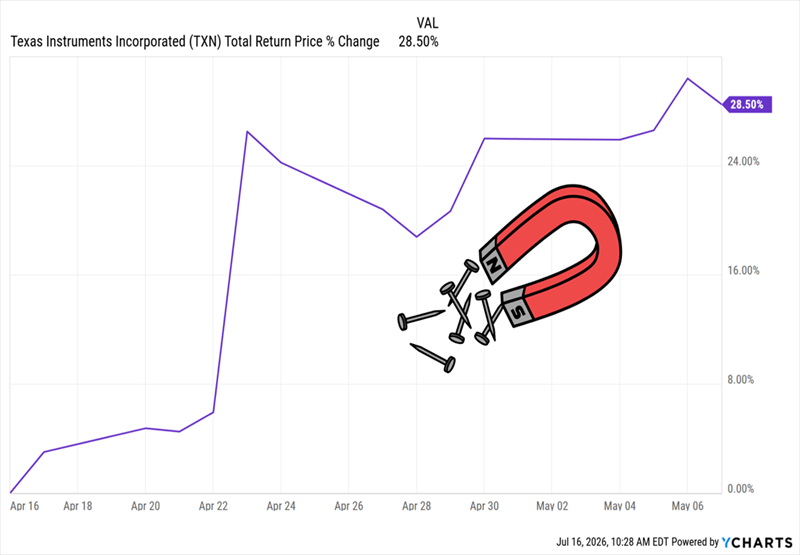
Note we’re not holding TXN today because, as we saw in our first chart, its price has rocketed ahead of its payout–and the Dividend Magnet works in reverse, as well, so it can pull down a stock that’s gotten too far ahead of itself.
So we’ve got TXN on our watch list–ready to move back in the next time its stock falls behind its payout. Instead, we’re targeting these two “dividend laggards” from our Hidden Yields portfolio.
“Dividend Magnet” Play No. 1: Home Depot (HD)
Another trend that’s well off the mainstream radar these days? The home-reno boom that’s quietly building across the country.
What’s driving it? Ironically, high mortgage rates, which make homeowners who took out mortgages with rock-bottom rates in 2020 and 2021 loath to move. So many are renovating their current places instead.
Many of these folks have also built up a lot of equity since 2021, and they’re not afraid to tap it to fund their upgrades.
In the first quarter, for example, balances on home-equity lines of credit jumped $14 billion from a year earlier, to $446 billion, according to the Federal Reserve Bank of New York. Meantime, spending on renos and maintenance is projected to hit a record $522 billion, according to the Harvard University Joint Center for Housing Studies.
The “maintenance” side of that spend is not to be sniffed at, either, considering the typical American home is now 44 years old.
These houses need new roofs. They need new pipes. The HVAC is about to wheeze its last breath. None of these problems care about interest rates, Middle East conflicts or AI. They need to be fixed–stat.
Put it all together and you have a setup for a multi-year reno bonanza. And when rates fall (and they will as the deflationary effect of AI rolls through the economy), we could be looking at Reno Boom 3.0 as some of those bargain-basement mortgage-rate payers take the plunge and relocate.
Home Depot (HD) is here for all of this. As I write, HD is more than 22% below all-time highs. That’s absurd for a company generating $14 billion in yearly free cash flow.
Management, meanwhile, is returning as much of that cash as possible: In the last decade, HD has bought back 19% of its outstanding shares and hiked its payout 238%. That charged up HD’s “Dividend Magnet,” as you can see below.
HD’s “Dividend Magnet” Is Due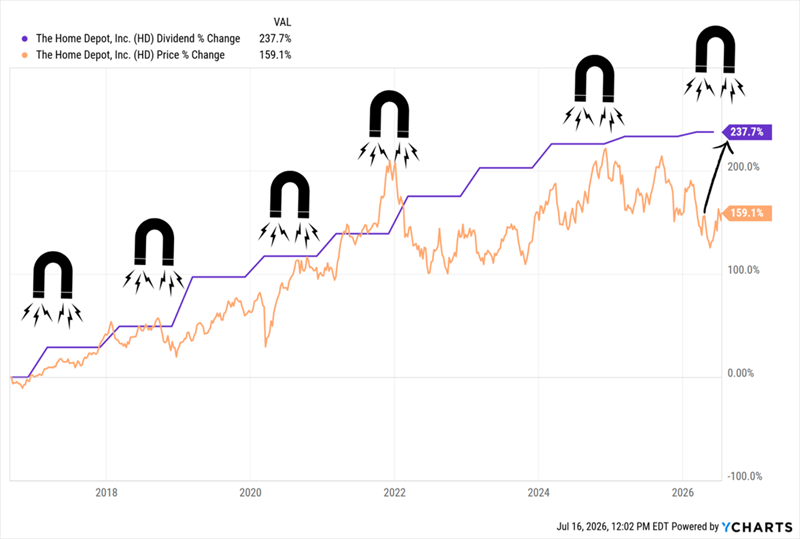
You can also see that the orange line (the share price) has split from the purple staircase since about last fall. That’s our upside: When that gap closes, we collect the difference.
Meantime, HD is catching more of what contractors spend through its Pro Desk, which, thanks to a couple recent acquisitions, makes it a top-to-bottom supplier for contractors.
Five years ago, a contractor who’d just landed a big job would’ve called three or four suppliers to get what they needed. Now they can wander up to the local Home Depot’s Pro Desk (or order online) and everything arrives from one source, on one truck.
The best part is, contractors need these materials whether the housing market is booming or busting, especially as American homes age. That makes HD’s revenue “sticky.” It sets us up for more payout hikes–and dividend-powered gains–too.
“Dividend Magnet” Play No. 2: Visa (V)
Our second stock runs the “plumbing” of the global payment system, processing 66.1 billion transactions in the second quarter alone. That’s Visa (V), which is often overlooked because of its “low” 0.8% yield. But that hides the power of “Big V’s” Dividend Magnet, which has made buying every dip in the last decade pay off:
Visa’s Dividend Magnet Makes Every Dip a Winner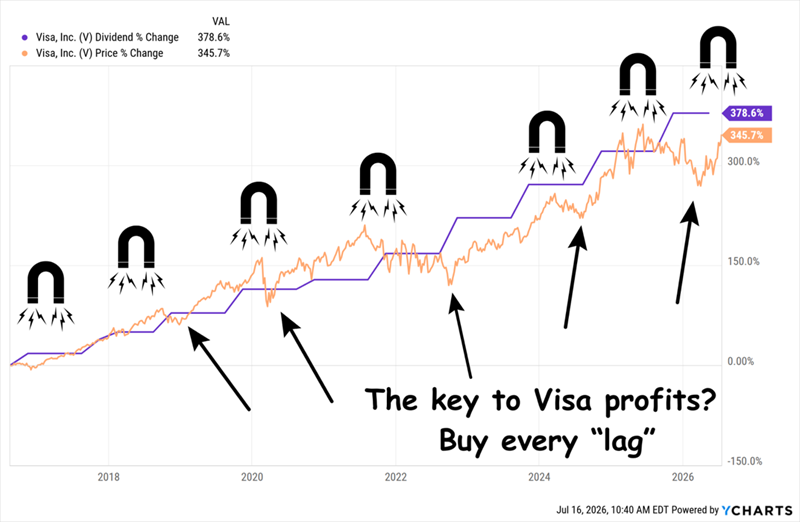
As you can see, “Big V’s” dividend isn’t just growing–it’s accelerating. And if you look closely, you can see that every dip in the last decade has been a buying opportunity.
Which brings us to now, with the stock trailing the dividend but moving closer over the last few weeks. That setup–a stock that’s lagging but gaining momentum–is a sweet buying opportunity for us.
That’s especially true when you consider that despite the gloomy headlines (which are, again, a plus for us!), consumer spending is holding up, and the labor market is stable. That helped drive a 9% gain in payment volume across Visa’s network in Q2.
A further tailwind? AI. It’s not just making Visa more efficient–it’s changing shopping habits as more consumers use it to quickly find what they want. Sellers are also boosting sales through hyper-focused ad targeting. This all points to more traffic–and transaction fees–for Visa.
The bottom line? Both Visa and Home Depot are strong, undervalued businesses whose Dividend Magnets are putting upward pressure on their lagging share prices. That makes now a great time to buy–before these stocks “snap back” to their payouts.
How to Put the Dividend Magnet to Work Right Now
Here’s something else you should know about the Dividend Magnet system: It is, as they say, “simple but not easy.”
That is, the pattern looks simple to spot: rising dividend, rising share price.
But we need to go further and be sure our dividend growers have the cash flow to keep growing–and ideally accelerating–them in the future.
I want to make it as easy as possible for you to put this proven system to work, so I’m going to give you my next 5 Dividend Magnet winners in an exclusive Special Report.
I’m forecasting 15%+ annualized returns over the long haul for these 5 stout payers, powered by their rock-solid–and growing–payouts. That’s enough to double our investment every five years!
Click here and I’ll tell you more about the Dividend Magnet and these 5 ignored dividend (and growth) plays. I’ll also give you your copy of that report for free, so you can grab these 5 “lagging” stocks now–and start collecting their growing payouts while we wait for their prices to follow suit.
Further TXN Research:
The views and opinions expressed herein are the views and opinions of the author and do not necessarily reflect those of Nasdaq, Inc.
